Licensing & safety
How UK gambling licensing works, and what it protects
A Great Britain licence is a set of obligations, not a badge of quality. Knowing which obligations they are tells you what to expect from every site on our list — and what no licence will ever give you.
18+ Independent · affiliate-funded • Responsible gambling • Updated 11 August 2026
Who licenses what
The Gambling Commission was created by the Gambling Act 2005 and regulates commercial gambling in Great Britain. The rule that matters most for online casinos arrived later: since the Gambling (Licensing and Advertising) Act 2014, any operator taking bets or casino play from customers in Great Britain needs a Commission licence regardless of where the company is based. A licence from Malta or Gibraltar is not a substitute, and advertising to British customers without a British licence is an offence.
That single change is why the five operators we compare all answer to the same rulebook, whatever their history or head office. It's also why the register is the first thing to check and the only thing that settles the question.

Two-minute check
How to check a licence yourself
The Commission publishes a searchable register of every licensed business and the trading names it operates under. Anyone can read it, and it takes less time than filling in a registration form.
-
Find the licence details on the site
UK-licensed operators must display their licence number and the licensee's name, usually in the page footer. Note the company name as well as the brand — they're often different.
-
Search the public register
Open the Gambling Commission's public register at gamblingcommission.gov.uk and search the licensee name, the licence number or the trading name you saw on the site.
-
Read the entry, not just the result
Check that the licence status is active, that the activities listed include casino games, and that the domain you're on appears among the account's trading names. A live licence for one brand doesn't automatically cover another.
-
Treat a mismatch as an answer
If the site isn't listed, or the entry looks nothing like what the footer claims, that's your decision made. There are enough licensed options that no one needs to gamble on the paperwork.
Where our five stand
Hollywoodbets, GRP Casino, Sky Vegas, Midnite and Paddy Power all present themselves as licensed for Great Britain, which is why they qualified for the comparison in the first place. We don't reprint licence numbers here, because they change hands and go stale; the register is authoritative and always current, so it's the link we point you to instead.
Standard protections
What the licence obliges an operator to do
These aren't features an operator chooses to offer; they're licence conditions. Anything below missing from a site that claims a Great Britain licence is a reason to look again at the register entry.
Age and identity verification
Since May 2019, operators must verify a customer's age before allowing any deposit or play, and before granting access to free-to-play versions of their games. The days of gambling first and proving your age later are gone.
GamStop integration
Since March 2020, participation in the national self-exclusion scheme has been a condition of holding a remote licence. Register once with GamStop and every UK-licensed operator has to refuse you an account.
Limits and time-outs
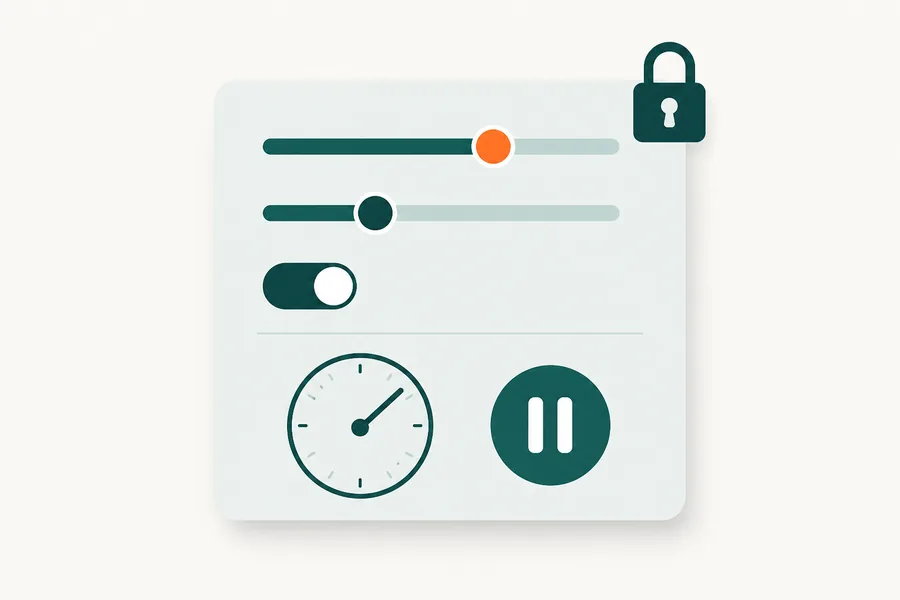
Deposit limits, session reminders and time-outs have to be available in the account area, and a request to lower a limit must take effect immediately rather than at the operator's convenience.
A route out of a dispute
Operators must have a published complaints procedure and must give customers access to an approved alternative dispute resolution provider if the complaint isn't resolved. The ADR service is free to the customer.
The slot rules most people have never read
In October 2021 the Commission tightened the design rules for online slots, and the changes are easy to notice once you know they exist. Spins can't be quicker than 2.5 seconds. Autoplay is banned outright, so every spin needs a deliberate action. Sounds and animations that celebrate a return smaller than the stake — the losses-disguised-as-wins trick — aren't allowed. Nor is any feature that lets you slam several games at once on the same site.
Operators also have to show you where you stand: total time played and net position have to be visible during a session. If a slot on a UK site behaves in a way these rules forbid, you aren't on a UK-licensed site.
What a licence does not do
It doesn't change the odds. Every casino game keeps a mathematical edge for the house, and that edge is legal, published in the game information panel as a return-to-player percentage, and entirely unaffected by regulation. A licence makes the process honest, not the outcome favourable.
It also doesn't make the Commission your advocate. The regulator polices operators; it doesn't arbitrate individual claims or recover losses. That's what the operator's complaints process and the ADR provider are for. And a licence certainly doesn't vouch for the value of a bonus — the wagering terms are yours to read, and the difference between a good offer and a decorative one is usually in the multiplier.
Once you're comfortable with the licensing side, the practical question is which product to use it on. Our scorecards compare five UK-licensed brands on lobby depth, live tables and app quality — and the myths page deals with the claims that survive purely because they sound plausible.